

Common Reasons for USA Business Visa Rejection
Understand why B-1 applications get refused under INA §214(b) and other grounds, and learn how to avoid these mistakes before applying
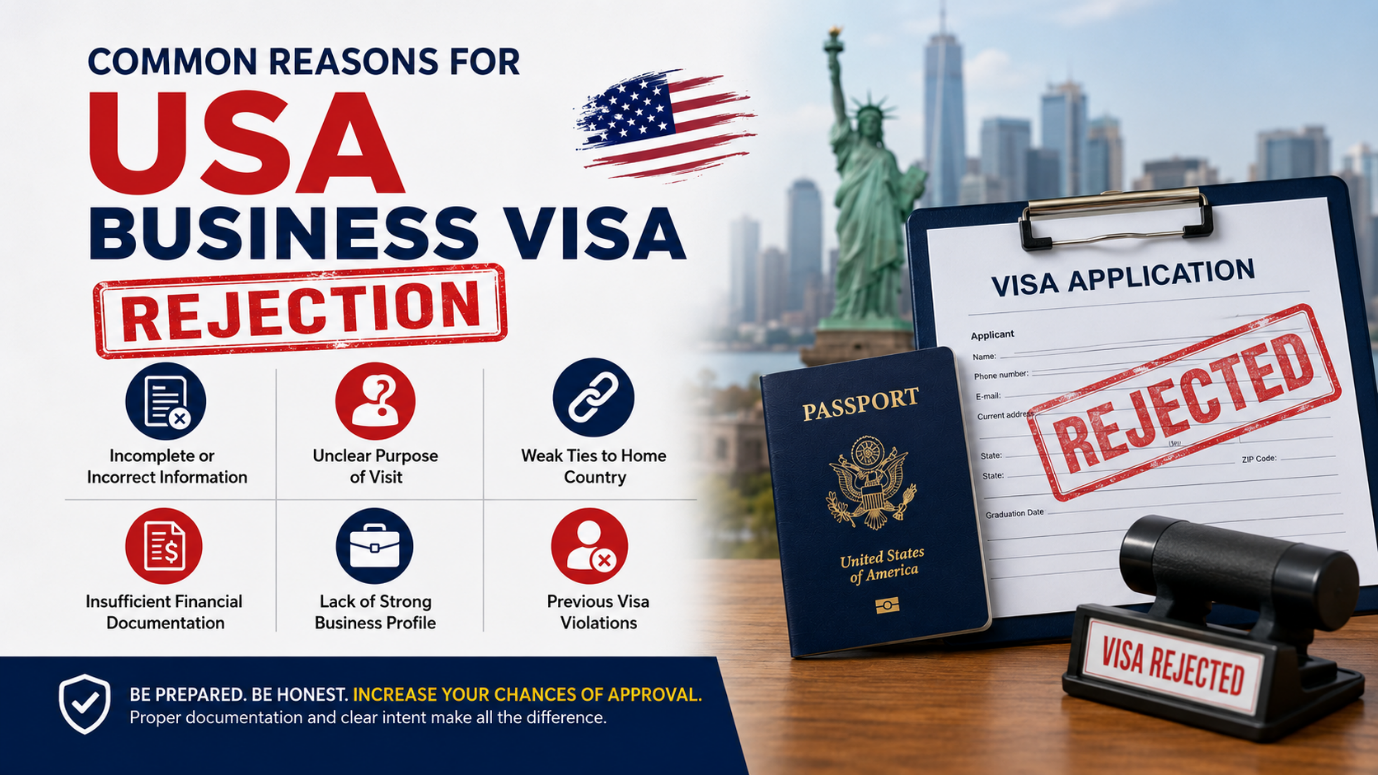
Top 10 Rejection Reasons
Based on INA §214(b), §212(a), §221(g), and documented U.S. consular refusal patterns.
1️⃣ Failure to Overcome INA §214(b) — Weak Ties to Home Country
Why It Matters: This is by far the single most common reason for B-1/B-2 refusals. Every applicant is legally presumed to be an intending immigrant until they prove otherwise. Weak employment, no property, being young/single with no dependents, or a thin travel history all work against you.
2️⃣ Unclear or Vague Business Purpose
Why It Matters: If your stated activity does not clearly fall within a permitted B-1 category (meetings, negotiations, conferences, etc.) or sounds vague, officers question your credibility and intent.
3️⃣ Insufficient or Unclear Financial Evidence
Why It Matters: Officers must be satisfied you can support yourself throughout the visit without working. Inconsistent income, low balances relative to trip cost, or unexplained large deposits all raise doubts.
4️⃣ Poor Interview Performance
Why It Matters: The consular interview is typically brief, and how you answer matters as much as your paperwork. Nervousness alone won't sink you, but inconsistent, evasive, or rehearsed-sounding answers will.
5️⃣ Inconsistent or Conflicting Documents
Why It Matters: Mismatches between your DS-160 answers, employment letter, bank statements, and verbal answers at interview suggest dishonesty or a poorly prepared case.
6️⃣ Misrepresentation or Fraud (INA §212(a)(6)(C)(i))
Why It Matters: Willfully misrepresenting a material fact, or submitting fraudulent documents, is one of the most serious grounds for refusal — it can result in permanent ineligibility, subject only to a discretionary waiver.
7️⃣ Prior Unlawful Presence or Overstay (INA §212(a)(9)(B))
Why It Matters: A history of remaining in the U.S. (or elsewhere) beyond authorized stay triggers statutory bars — 3 years for 180 days-to-1-year unlawful presence, 10 years for over a year — and heavily damages credibility even outside the bar period.
8️⃣ Self-Employed/Freelancer Documentation Gaps
Why It Matters: Freelancers and consultants lack traditional payslips, so officers scrutinize business legitimacy and income stability more closely.
9️⃣ Administrative Processing Delay (INA §221(g))
Why It Matters: This is technically a temporary refusal pending further review or missing documents — not a final denial — but it can significantly delay or, in some cases, ultimately result in denial if the underlying concern isn't resolved.
🔟 Previous B-1/B-2 Refusal Without Addressing the Underlying Concern
Why It Matters: A prior 214(b) refusal is on record and consular officers can see it. Reapplying with essentially the same facts, without any material change, is very likely to result in the same outcome.
How to Prevent Rejection
Proactive strategies to strengthen your USA business visa application
✓ Financial Preparation
Maintain consistent bank statements for 6+ months. Show regular income patterns. Avoid large unexplained deposits close to application date. Provide clear documentation for any legitimate large deposits.
✓ Business Purpose Documentation
Get a detailed (though not legally mandatory) invitation letter from your U.S. contact. Include meeting dates, locations, and purpose. Attach conference registration or contracts showing the business relationship.
✓ Document Quality & Consistency
Verify that all figures and dates match across your DS-160, employment letter, and bank statements. Use certified translations for non-English documents.
✓ Ties to the UAE
Bring evidence of stable employment, tenancy/property, family commitments, and active UAE business registration. Demonstrate a credible, ongoing reason to return.
✓ Interview Preparation
Practice clear, honest, consistent answers about your job, funding, and travel plan. Never suggest openness to staying long-term or seeking U.S. employment.
✓ Strategic Timing
Apply well ahead of travel (interview wait times vary widely). Never apply under time pressure, which leads to incomplete files and rushed interviews.
Special Risk Areas for UAE Applicants
Specific challenges UAE business residents face
🏢 Business Owner Challenges
Risk: A trade license alone doesn't prove business legitimacy or ties. Solution: Provide business bank statements, invoices, client contracts, and a clear, documented relationship with your U.S. contact.
👔 Self-Employed Challenges
Risk: Proving stable income without traditional employment. Solution: Provide 12-month bank statements, client contracts, invoices, and business registration to establish legitimacy and income consistency.
💰 Financial Scrutiny
Risk: Sudden deposits or irregular income raise red flags. Solution: Maintain 6-month statements minimum with regular patterns, and document any large deposit's source.
📬 Invitation Letter Issues
Risk: A generic or unverifiable US invitation letter can weaken (not fatally, since it's optional) your stated purpose. Solution: If used, get a personalized letter with company details, dates, and a clear description of the relationship.
🏘️ Weak Home Ties
Risk: Cannot demonstrate why you will return to the UAE. Solution: Employment letter, family ties, property ownership, and business commitments all help build a credible return narrative.
⏰ Last-Minute Applications
Risk: Rushing leads to incomplete files and unprepared interviews. Solution: Apply well ahead of travel dates and check current interview wait times at your specific embassy/consulate before booking travel.
FAQs: Refusals & Reapplication
Answers to common questions about USA visa refusals